
I love America. I was lucky enough to work for a wonderful American company for 16 years, and cherished the friendships of many fine American colleagues. But the transformation of the leader of the free world into a cheerleader for brutal dictatorship and the far right cannot be ignored.
In 1776, 13 American colonies declared independence from Great Britain. Just short of the 250th anniversary of that historic event, the perfidious actions of the 47th president of the resulting United States of America make it essential for Britain itself to break free.

Like millions of Europeans, I was appalled to see President Trump bully and humiliate Ukraine’s President Zelenskyy in what looked like a hostage video staged in the White House. Trump and Vance constantly interrupted the beleaguered Ukrainian leader, who valiantly tried to cope with the flood of invective. At the very same time Trump was abusing his counterpart, the American president’s friend Vladimir Putin’s forces were killing Zelenskyy’s fellow citizens, as they have been since 24 February 2022.
“You are gambling with the lives of millions of people. You’re gambling with world war three,” Trump told a man whose country had been invaded by a brutal dictator intent on wiping Ukraine off the map. Fortunately, America’s greatest president, Franklin Roosevelt, took a different line in 1941 with Winston Churchill. Rather than bullying Britain’s wartime prime minister into accepting an armistice with Hitler, Roosevelt gave extraordinary support for his fight for national survival. Alongside the heroic efforts of the Soviet Union, that ensured that Europe was liberated from the tyranny of Nazi rule less than four years after America entered the war.
I am usually very reluctant to mention the Nazis (people do this all too often), but the shocking encounter at the White House reminded me of the humiliation in 1938 of Austria’s chancellor Kurt Schuschnigg, subjected to a terrifying two hour tirade by Adolf Hitler in the dictator’s mountain retreat at Berchtesgaden, Bavaria. ‘You have done everything to avoid a friendly policy!’ Hitler screamed. ‘And I can tell you right now, Herr Schuschnigg, that I am absolutely determined to make an end of this.’ The Anschluss – the Nazis’ forced union of Germany and Austria – came the following month, with appalling consequences for Austria’s Jews and countless others. Austria only became an independent country again in 1955, 10 years after the second world war.

Munich is a city with dark associations. In September 1938, Britain and France betrayed Czechoslovakia in the Munich agreement with Hitler, which gave that unhappy country’s Sudetenland region to Germany, after relentless provocations from the Nazis. The Czechs were not allowed to take part in the talks that ended in the dismemberment of their country. Yet, unlike Trump, Britain’s Neville Chamberlain had noble objectives in his ignoble surrender to Hitler. As Tony Blair realised after reading Chamberlain’s diaries, his predecessor was painfully alive to the führer’s evil nature, but naively hoped that Nazi Germany would see sense. It’s hard to see any such noble intentions behind Trump’s championing of the evil Putin at the expense of Ukraine’s freedom. A compromise may have to come – but not through Trump’s amoral, bullying of a nation under siege.
Another grim Munich association was created last month when Trump’s vice president James Vance appalled Europeans at the Munich security conference by saying the greatest threat facing their continent was not from Russia and China, but from within. Imagine how that felt to someone in Ukraine, victim of Russia’s brutal invasion, suffering the trauma of being raped, maimed or bereaved by Russia’s violations. Three days later, Trump described Ukraine’s Zelenskyy as a dictator. This from a man who incredibly wants to reward Putin for the worst war of aggression in Europe since 1945, and who has threatened allies as varied as Canada and Denmark.
The Times published an extraordinary leader column two days before Trump humiliated Zelensky. Its excoriating verdict:
“Never before has the US voted with Russia and against its Nato allies on a UN resolution relating to security on this continent. The world’s greatest democracy, for 80 years its global policeman, is going rogue. Seemingly, it is no longer the criminal regimes in Moscow, Minsk, Tehran and Pyongyang that have cause to fear the US but its democratic allies. The Trump administration appears to glory in the intimidation and humiliation of long-standing friends.”The Times, London, Wednesday 26 February 2025
Keir Starmer: appeasing Trump

British prime minister Keir Starmer must have been delighted by initial news coverage in Britain of his own visit to Donald Trump. He seemed to have protected Britain from tariffs on exports to the United States. Yet within hours, he would have been sickened by Trump’s disgraceful treatment of Volodymyr Zelenskyy. Starmer’s flattery of Trump with a second state visit now looks disastrously ill-judged, a shameful bargain with a man with a massive ego and no principles. Trump cannot be appeased. Every surrender feeds his gigantic ego and deluded belief that he is always right.

Europe alone
In the dark days of June 1940, after the fall of France, Nazi troops were within sight of the white cliffs of Dover, with just 26 miles of sea separating Britain from the might of Hitler’s all-conquering armies. David Lowe’s famous cartoon in London’s Evening Standard captured the mood of a stunned British nation. Just nine months earlier, John F Kennedy, aged 22, was present in the House of Commons to hear Neville Chamberlain confirm Britain’s declaration of war on Nazi Germany on 3 September 1939. Kennedy, like all postwar American presidents until Trump, was steadfast in his defence of freedom. At the risk of sounding melodramatic, Europe today faces a similar grim challenge to 1940. It is clear that America, land of the free, is no longer the friend of the free, or the champion of the oppressed and conquered. Europe must go it alone.
America’s noble sacrifice for European freedom
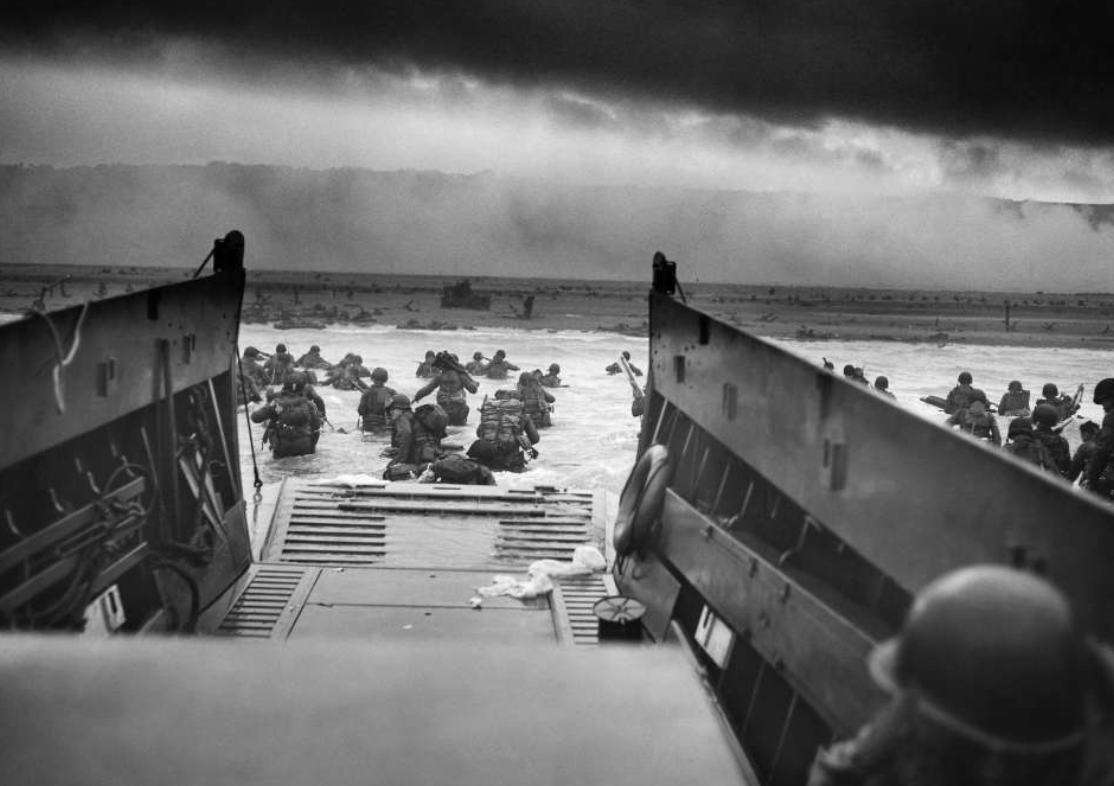
As Europe comes to terms with the loss of its greatest ally, we should never forget the sacrifices America made in human life and treasure liberating our continent 80 years ago. The greatest generation of Americans left their fortress homeland, in many cases for the first time, to risk their lives on land, sea and in the air. And America continued to spend a fortune keeping western Europe secure in the face of a Soviet Union that had enslaved the nations of Eastern Europe after vanquishing Hitler. Today’s European Union exists in part because of that American sacrifice, as well as western Europe’s determination to turn its back on the catastrophic wars that had ruined so many lives.
Ronald Reagan beautifully summed up the spirit of the young American men who stepped shore on the beaches of Normandy in June 1944. Speaking at the 40th anniversary of D Day in 1984, he said:
‘You were young the day you took these cliffs; some of you were hardly more than boys, with the deepest joys of life before you. Yet, you risked everything here. Why? Why did you do it? What impelled you to put aside the instinct for self-preservation and risk your lives to take these cliffs? What inspired all the men of the armies that met here? We look at you, and somehow we know the answer. It was faith and belief; it was loyalty and love.’
Reagan also spoke words that shame his successor 41 years on:
‘We in America have learned bitter lessons from two world wars: It is better to be here ready to protect the peace, than to take blind shelter across the sea, rushing to respond only after freedom is lost. We’ve learned that isolationism never was and never will be an acceptable response to tyrannical governments with an expansionist intent.’
You don’t have to be a Trump supporter to recognise that Europeans haven’t always been grateful enough for American support and sacrifice. A week ago, Britain’s New Statesman news magazine published a letter from one David Murray. He called (pre-Trump) America ‘the word’s premier bully’, a ridiculous description that defies belief when compared with Soviet, Russian and Chinese tyranny. The European left have often been far more critical of America than of Soviet, Russian, Chinese or Latin American dictatorships. It’s easy to see why many Americans curse their ungrateful allies. But that’s no excuse for Trump’s thuggish alliance with Putin’s Russia, or his threats to traditional NATO allies.
Starmer’s destiny: choose Europe
In 2022, I wondered whether Keir Starmer might just transform British politics and become, in time, Labour’s longest serving prime minister. The first eight months of Starmer’s government made that seem a very unlikely prospect. Starmer appeared paralysed by caution, buffeted by events. But the crisis unleashed by Donald Trump gives him a unique opportunity. But he will have to raise his game dramatically to seize the moment. As Tony Blair said just weeks after the 9/11 terrorist attacks on America, ‘The kaleidoscope has been shaken. The pieces are in flux. Soon they will settle again. Before they do, let us re-order this world around us’. Today, Britain and Europe must unite to shape our continent’s destiny, relighting the flame of freedom that America has extinguished.
Starmer needs to tell a compelling story against which to explain the boldest policy decisions. An unprecedented challenge requires unprecedented action. The world has changed more dramatically than at any time since 1945. (America abandoning freedom and supporting the invaders of a European democracy is potentially more seismic than the fall of the Berlin wall.) Britain must choose Europe over America.
At the same time, we have to face the fact that Putin’s aggression and Trump’s new world order change our essential priorities. We must spend more on defence. It was right to shift spending from ‘guns to butter’ after 1990, when the cold war ended, allowing Britain to bring home its 55,000 troops still stationed in Germany 45 years after the end of the war. But we spent that peace dividend many times over, and during the past decade our defences have been dangerously run down. We have to change that, and quickly. As we found to our cost in the 1930s, a government that neglects a nation’s defences is taking a very dangerous gamble.
Labour’s election promise not to raise income tax now looks even more foolish than before Zelensky walked into the White House. Starmer will never have a better reason to explain why income tax will have to rise. The divided Conservative opposition would be in no place to complain: in the 1980s, they ran an election campaign poster headlined Labour’s policy on arms, with the image of a soldier with his hands held up. Labour can now turn the tables if the right protest.
This is also the moment for Starmer to confront the Brexit warriors by declaring that Britain will rejoin the European single market and customs union. This would boost economic growth at a stroke and improve productivity: an end to all that pointless red tape and queues at Dover and other international borders. If anyone dares say this was not what the British people voted for in the 2016 referendum, remind them that the leading Brexiters said the UK would remain in the single market after Brexit. And if Trump imposes tariffs on the EU and UK, we will have the cushion of being in the world’s largest single market, a benefit Theresa May and Boris Johnson threw away on Brexit.
But defending Europe will take more than the EU, an organisation increasingly weakened by the rise of the far right, such as Hungary’s Viktor Orbán, who competes with Trump in his devotion to Putin. And the very future of Nato is threatened by Trump. Europe may need to create its own version, operating alongside Nato and the EU.
The sorrow of a lost America
The United States remains a remarkable country, despite its current leadership. I know many of my American friends will feel the loss of the America that led the free world even more deeply than we do in Europe. I remember the pain they felt during the first Trump presidency. We can all but hope that the free world will emerge intact from the Trumpian nightmare.
PS: Very well, alone, 1940
The idea that Britain stood alone in 1940 is part of the enduring legend of that extraordinary year. But the country wasn’t completely alone: men from the dominions of Canada, Australia, New Zealand and South Africa fought alongside the British, as did thousands from other parts of what was still the British Empire. Hundreds of pilots exiled from Poland, Czechoslovakia and other countries invaded by Hitler fought and died in the Battle of Britain. The sacrifices of these brave people helped secure eventual victory in 1945.
 Ertblog